I feel quite shaken by the level of uncertainty associated with knowledge that presents itself at a university level. After almost a semester in medicine, it has become apparent that while we write volumes on what we do know, my reference books are regularly admitting that certain mechanisms and various aetiologies of numerous conditions, esoteric and common, are rather opaque to us. There are even occasional inconsistencies between sources, which does nothing to assuage my fears that academia in general is in danger of building castles upon castles in the cloudy skies above the ivory tower.
It ought to be exciting, that we know so little, because it speaks of the possibilities out there, the research to be conducted, the potential applications and miracle cures that might present themselves upon the successful comprehension of various pathways.
Yet, it seems as though these vast unexplored regions of undiscovered knowledge have been cached in a collective wilful ignorance. Only a select few peer out over these shadowy realms and tremble at its inexhaustible expanse, the rest have come to believe that someone else always has the answers.
Perhaps it is a consequence of specialisation, coupled with the socha of modern life. Professionals want others to believe that they have all the answers, as part of earning the trust of the majority who entrust their information, assets and occasionally, their very lives to those who are likely complete strangers. Society interrogates their professionals with the question: 'You know what has to be done, right?'
Often, we can confidently answer that yes, we do know how we can help. This has unfortunately led to the perception that we have, collectively, got all the answers. That, in turn, has led to terribly high expectations and to the readiness at which we interpret mistakes as malevolent manipulation of some secret gnosis.
We want to believe that we know enough, for as the adage goes, knowledge is power. We would like to believe that we have more control over our fates than our less informed ancestors. In truth, we ought to know that we know little, that our knowledge base is vulnerable and often incomplete, and we plug ourselves into a global system that wants desperately to conceal the fragility of its foundations. How long will it be before the pride of our modernity is irrevocably shown to be a passing illusion? The sentiment of 'sic transit gloria mundi' will undoubtedly reverberate till kingdom come.
28 October 2015

3 October 2015
De Imagine Dei
This is going to be a fairly short article on my current understanding of what it means for God to have created us in His image.
To begin, this concept is based on the Word, and blended funnily enough, with a little bit of dimensional speculation from Flatland, by A. Square.
Then God said, “Let us make man in our image, after our likeness. And let them have dominion over the fish of the sea and over the birds of the heavens and over the livestock and over all the earth and over every creeping thing that creeps on the earth.” So God created man in his own image, in the image of God he created him; male and female he created them.
- Genesis 1: 26-27 (ESV)
What is an image? In our most frequently encountered expression of images, they are two dimensional representations of something in three dimensions. By virtue of the fact that we see things from a limited perspective, we are able to represent something of three dimensions in a recognisable fashion, even through it has much less information than what the image claims to represent.
So an image is a snapshot of something complex from a limited perspective. It is a representation of something in a lower dimension that can only exist in a higher dimension. An image of a hypercube would be a cube, that of a cube, a square, and that of a square, a line, and a line, a point. Or not.
Depending on the angle at which the image is taken, a cube can look like a hexagon or a rectangle. A scene can be viewed from a thousand perspectives. A building, whether le tour Eiffel or the Sydney opera house, have an near infinite number of possible vantage points by which they may be reduced to an image. Some may be more familiar than others, more or less conventional, close or distant.
If we are images of God, by this analysis, God must be more complex than we are. Our most distinguishing factor as human beings is that we are personal. We have the ability to form personal relationships with one another, and with God, in a way that the rest of natural creation cannot. What is a more complex version of personality? Father, Son and Holy Spirit.
Trinity is only possible in what is somehow an additional personal or spiritual dimension, which we are unaware of in the same way that A. Square could not, at first, conceive of a sphere. In order for God to explain Himself to us, He has to reduce Himself into relatively comprehensible expressions. Most directly, by dipping Himself into our dimension as Jesus Christ. As how the sphere appears as a circle in Flatland to be able to communicate in a limited way with his prophet.
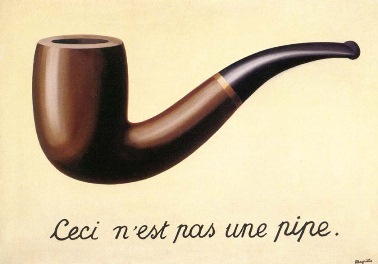
We are all made in God's image, yet we possess such diversity in our expression of that image. The analogy still holds, for a complex being like God cannot be captured in His entirety by a single image, a single human being. In His infinitude, all the billions of us who have ever existed still cannot fully capture all the ways that God can be imaged. And of course, while we may look like God when He is viewed from a certain angle, we cannot hope to be Him, any more than a picture of a pipe can be a pipe.
Subscribe to:
Comments (Atom)