This past Saturday was the penultimate FBI - Creationism session, and the speaker went through :
I. Fossil Evidence for the Flood
II. Geological Evidence for the Flood
III. A Diluvian Explanation for the General Characteristics of the Fossil Record
IIII. The Cambrian Explosion
V. Fossil Fuels
VI. A Mechanism for the Flood
VII. Introducing Dinosaurs
I'm rather conflicted about where I should take Eldwan now, given that I had an alternate inclusion of issues like continental drift and catastrophism, and a local flood rather than a global one. I wonder if I should alter my mythos or just remain with it to postulate a different universe instead of one with many parallels. Anyway, moving on to the material presented:
I. Fossil Evidence for the Flood
Now that it has been highlighted, it does seem very odd, that there should be intact fossils of fish in a scavenger laden environment like the ocean. Instead we observe many fossils, buried rapidly and intact, some in the process of consuming other fish. This implies a catastrophic event which was responsible for such burials in a swift and interruptive manner.
Additionally, animal fossils are also found in massive fossil beds, the remains of creatures piled up on one another, implying a large catastrophic event, rather than gradual accumulation.
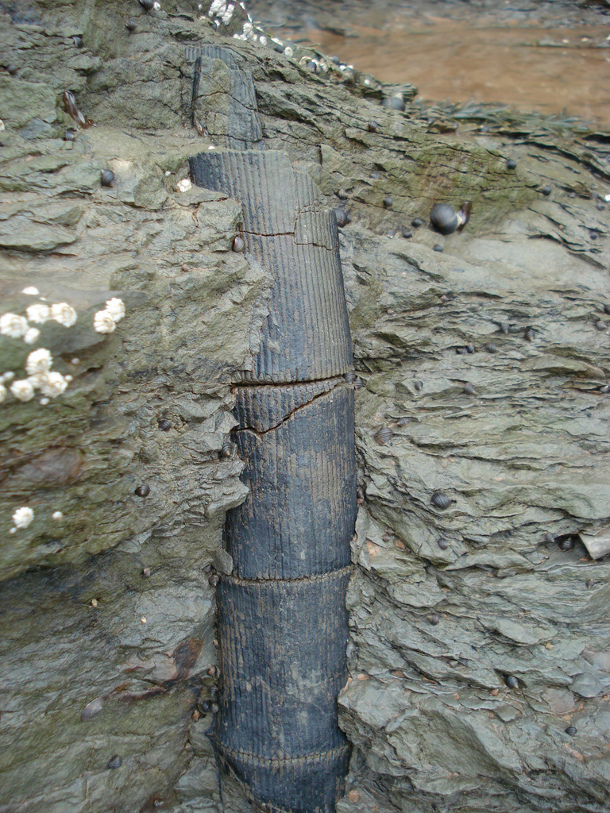
Trees are also found buried in geological strata, cutting through many layers at once. These polystrate trees do away with the idea that the strata in between could have been formed gradually over millions of years. Some of these trees trunks are even found slanting or upside down, which defies any explanation that they were gradually buried while they were still alive.
II. Geological Evidence for the Flood
The speaker notes unusual geological formations, such as submarine river canyons, such as the Hudson river valley. This canyon extends far beyond the modern sea coast. If there was a flood where water covered all the earth, we would expect to see large canyons formed as the water drained back from continental land. Other canyons such as the Grand Canyon would also have been formed from similar massive runoffs, with concomitant erosion carving huge structures. The present day rivers are rather out or proportion with the canyons they are found in. The same evidence, viewed from a different perspective.
Furthermore, how does one really expect that layers upon layers of rock can be added on dry land, without rain or wind eroding each layer. The ground does not remain undisturbed for fossils and dirt to accumulate in the natural world. Are we to accept that it did happen simply because the time scales claimed boggle the imagination?
The types of rocks found, sedimentary, turbidite or conglomerate rock, all suggest movement of
III. A Diluvian Explanation for the General Characteristics of the Fossil Record
This section was a little contradictory for me, as the speaker had spent a long time discussing the incompleteness of the evolutionary history as presented by the geological column. Now he states that there is a general order of fossils found higher or lower than others, though there are plenty of exceptions. His point was, if the implications of a flood are considered, there would be a semblance of progression. The immobile, simple sea organisms would be buried first, since they would be quite helpless in the face of the great movements of soil and silt brought on by the flood. Second, other sea life would be trapped. He points out that the vast majority of fossils are corals and shellfish, followed by sea plants and marine invertebrates. Next amphibians, which are found in low lying, water rich areas, would be buried next, then slow moving reptiles and animals. Animals that could move quickly would have been able to avoid disaster for longer. Finally of course, human beings, who would have understood what was happening and known their local topography, would have headed for higher ground as much as they could help it, avoiding mudflows and burial, eventually drowning. Their bodies, though, would be floating above the sediments churning in the waters below, and would likely be decomposed instead of fossilised.
If this explanation is true, there would also be room for some exceptions, as there might be poor unfortunates buried much earlier than their peers or vice versa. Evolution is unable to counter these apparent anachronistic anomalies.
IIII. The Cambrian Explosion
The Cambrian Explosion is easily explained by the flood, mudflows trapping a vast numbers and varieties of sea organisms to produce an abundance of fossils. Evolutionists can only state that it was a period of unusually fast evolutionary action and mutation, which sounds rather unconvincing, harkening back to punctuated equilibrium.
V. Fossil Fuels
The speaker submits that there is a lack of evidence that naturalistic processes can form coal or oil. Experiments have been done that show that fossil fuels can be formed rapidly under the right conditions. Once again, I wish the speaker would give footnotes for these facts which are seemingly pulled from the nether. The speaker also references the pressures that oil is found under, when it is tapped. He states that such high pressure would not have lasted for so many years, rather the oil would have dissipated into the surrounding rocks.
VI. A Mechanism for the Flood
We now move to a possible way by which the flood was enacted. Genesis 7 notes fountains of the deep, which are hypothesised to refer to vast subterranean vaults of water, which could have been released by a cataclysmic event through the earth's crust, blasted into the earth's atmosphere along with dust, which would lead to massive amounts of precipitation. There is a view that holds the mid-atlantic ridge as the site of such a fracture. The uplift of the seafloor would have pushed the continental shelves far apart, and this would also have had the effect of triggering tsunamis. This would have pushed the continents apart, including an explanation for continental drift. The ark could have survived all this tumult by floating over the waves, as tsunamis are not dangerous in open water, but only when their kinetic energy is destructively dissipated along the coast. Eventually, the tectonic movements would have slowed and the new seafloor would have cooled, sinking as it did. This would allow water to drain back into the oceans, creating the river canyons as they did so.
VII. Introducing Dinosaurs
The speaker simply begins with the fact that dinosaurs are also a part of creation, and were made to reflect the glory of the Creator. There is no reason why they cannot be fit into the biblical narrative like any other extinct species. It could be noted that dinosaurs may have survived and thrived in an antediluvian environment, but after the flood, the climate was too adverse for them and they died out. He stops about here, leaving the rest of the dinosaur discussion for the final FBI session.



No comments:
Post a Comment